1.1Singleton Pattern
Ensures a class has only one instance while providing a global access point to this instance.
Gangs of Developers Editorial Team
Distributed Systems & Software Architecture Blueprint SeriesKey Takeaways
Restricts instantiation of a class to a single object, strictly controlling hardware resources, socket pools, or configuration stores.
Guarantees thread safety and safe publication across concurrent worker threads using double-checked locking, initialization-on-demand holder, or enum singletons.
Must be guarded against hidden global state anti-patterns, unit test coupling, and reflection/serialization bypass vulnerabilities.
UML Class Architecture & Structural Topology
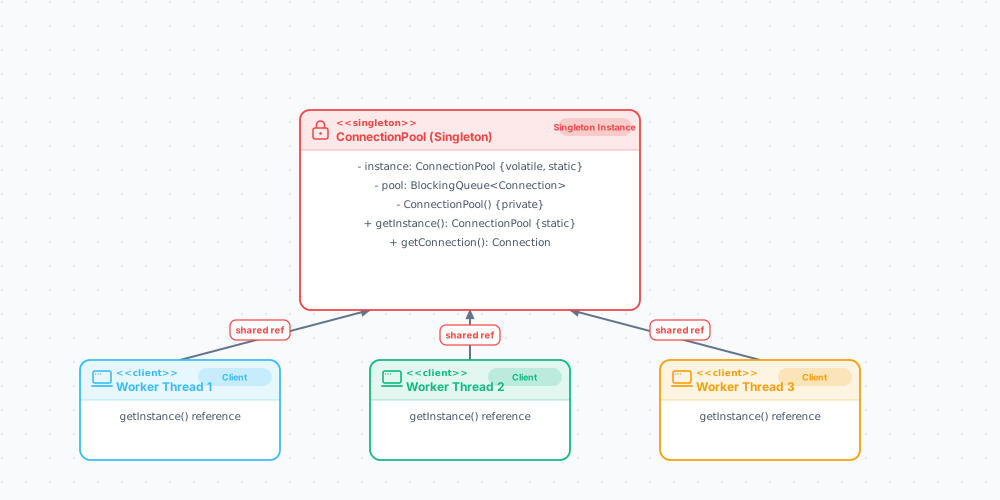
Architectural Intent, Invariants & The Singleton Debate
The Singleton pattern addresses scenarios where a single shared coordinator must manage access to an underlying physical or logical resource—such as a database connection pool, a hardware driver, or a global configuration registry. By privatizing the class constructor and exposing a centralized static access point, Singleton ensures that consumers cannot accidentally allocate competing or duplicate instances.
Controlled Access to Unique Resources: Prevents port exhaustion, thread pool saturation, or conflicting filesystem locks by routing all calls through a single manager.
Lazy vs Eager Instantiation: Eager initialization creates the instance at class-loading time, whereas lazy initialization defers heavy resource allocation until the first call to getInstance().
Encapsulated State: Keeps internal state modifications guarded behind thread-safe methods rather than exposing raw mutable global variables.
Concurrency Hazards, Memory Barriers & The JVM Memory Model
Under multi-core CPU architectures, a naive lazy singleton (if instance == null then instance = new Singleton()) creates severe race conditions. Two threads entering the conditional check concurrently will allocate two independent instances. Moreover, modern CPU pipelining and compiler optimizations reorder instructions: memory allocation can be assigned to the static reference pointer before the constructor finishes executing its internal field assignments. A concurrent thread reading the non-null reference will therefore read a partially initialized, corrupted object.
Double-Checked Locking (DCL): Tests the reference without locking first; only acquires the synchronized mutex if null, followed by a second sanity check inside the lock.
Volatile Memory Fence: The 'volatile' modifier instructs the compiler and CPU memory bus to establish a happens-before relationship, guaranteeing that constructor execution completes before the memory address is published.
Bill Pugh Holder Idiom: Leverages the JVM ClassLoader specification. Inner static helper classes are loaded and initialized only upon first access, achieving 100% thread safety without synchronization overhead.
Failure Modes: Testing Pitfalls, Hidden Coupling & Anti-Patterns
Senior software architects often classify Singleton as an architectural anti-pattern when abused. Because singletons provide ambient global access, components that consume them hide their true external dependencies, severely violating the Dependency Inversion Principle. Furthermore, mutable singletons create cross-test contamination in unit test suites, where test case order affects test pass/fail results.
Hidden Temporal Coupling: Methods invoking Singleton.getInstance() internally cannot be mocked or isolated in unit tests without bytecode manipulation frameworks.
Reflection and Serialization Bypass: In languages like Java, reflective setAccessible(true) or ObjectInputStream deserialization can bypass private constructors unless explicitly guarded.
Cluster vs Process Scope: A Singleton is only single per ClassLoader / OS Process. In multi-pod distributed cloud deployments, each container has its own singleton, requiring Redis or ZooKeeper for true distributed coordination.
Production Blueprint: Modern Idiomatic Implementations in Java 21
The following production Java implementation showcases the three canonical thread-safe approaches: Bill Pugh Initialization-on-demand holder, Double-Checked Locking with volatile memory fences, and Joshua Bloch's Enum Singleton which is reflection- and serialization-proof.
Bill Pugh Idiom: Cleanest, highest performance lazy initialization with zero mutex lock overhead.
Enum Singleton: Canonical Effective Java approach providing compile-time serialization safety.
| 1 | // Approach 1: Bill Pugh Initialization-on-Demand Holder (Recommended for Lazy Loading) |
| 2 | public final class DatabasePoolHolder { |
| 3 | private DatabasePoolHolder() { |
| 4 | // Guard against reflection instantiation hacks |
| 5 | if (Holder.INSTANCE != null) { |
| 6 | throw new IllegalStateException("Singleton instance already created"); |
| 7 | } |
| 8 | } |
| 9 | |
| 10 | private static class Holder { |
| 11 | private static final DatabasePoolHolder INSTANCE = new DatabasePoolHolder(); |
| 12 | } |
| 13 | |
| 14 | public static DatabasePoolHolder getInstance() { |
| 15 | return Holder.INSTANCE; |
| 16 | } |
| 17 | } |
| 18 | |
| 19 | // Approach 2: Double-Checked Locking (DCL) with Volatile Fence |
| 20 | public final class DclConfigurationManager { |
| 21 | private static volatile DclConfigurationManager instance; |
| 22 | private final Map<String, String> configs = new ConcurrentHashMap<>(); |
| 23 | |
| 24 | private DclConfigurationManager() {} |
| 25 | |
| 26 | public static DclConfigurationManager getInstance() { |
| 27 | DclConfigurationManager result = instance; |
| 28 | if (result == null) { |
| 29 | synchronized (DclConfigurationManager.class) { |
| 30 | result = instance; |
| 31 | if (result == null) { |
| 32 | instance = result = new DclConfigurationManager(); |
| 33 | } |
| 34 | } |
| 35 | } |
| 36 | return result; |
| 37 | } |
| 38 | } |
| 39 | |
| 40 | // Approach 3: Enum Singleton (100% Immune to Reflection & Deserialization Attacks) |
| 41 | public enum EnterpriseMetricsRegistry { |
| 42 | INSTANCE; |
| 43 | |
| 44 | private final AtomicLong counter = new AtomicLong(); |
| 45 | |
| 46 | public void incrementMetric(String metricName) { |
| 47 | counter.incrementAndGet(); |
| 48 | } |
| 49 | } |
Architectural Trade-Off Matrix
Evaluating production alternatives, concurrency bottlenecks, and operational costs.
| Pattern / Approach | ✓ Key Architectural Advantages | ⚠ Trade-Offs & Complexity | ★ Production Recommendation |
|---|---|---|---|
| Bill Pugh Holder Idiom | Zero synchronization penalty, purely lazy initialization backed by JVM ClassLoader guarantees. | Cannot pass dynamic initialization arguments to the constructor during first retrieval. | Default high-throughput lazy initialization in JVM applications. |
| Double-Checked Locking (DCL) | Supports dynamic parameterized constructor arguments during lazy initialization. | Requires strict 'volatile' semantics; verbose boiler-plate code prone to implementation mistakes. | Scenarios requiring runtime configuration parameters passed on initial singleton bootstrap. |
| Dependency Injection (Singleton Scope) | Decouples callers, allows mock injection during testing, adheres to Dependency Inversion Principle. | Requires an inversion-of-control container (Spring, Guice, NestJS) managing application lifecycle. | Modern microservices and enterprise applications where testing and modularity are paramount. |
GOD Architecture Interview Pro-Tip
In technical architecture interviews, when asked to design a Singleton, immediately mention: 'While Double-Checked Locking demonstrates knowledge of the Java Memory Model and memory barriers, in production I prefer Dependency Injection frameworks (like Spring @Service singleton scope) or the Bill Pugh Holder idiom. A raw static Singleton introduces hidden global state and breaks unit testing.'