1.1Monolith vs Microservices Architecture
Analyzing architectural trade-offs, network latency tax, team topologies, and knowing exactly when to split.
Gangs of Developers Editorial Team
Distributed Systems & Software Architecture Blueprint SeriesKey Takeaways
A monolithic architecture offers zero-latency in-memory function calls (10–50ns) and ACID atomicity; microservices trade this for independent deployment velocity and isolated blast radius at the cost of network hops (1–5ms).
Beware the 'Distributed Monolith' anti-pattern: microservices that share databases, require lockstep deployments, or chain 10+ synchronous RPCs combine the worst of both worlds without the benefits of either.
Default to a clean Modular Monolith early in product evolution until domain boundaries stabilize and team size surpasses 30+ engineers.
Conway's Law is the primary driver: organizations split architectures to scale independent engineering teams, not merely to scale CPU cores or database queries.
Every network boundary crossed converts deterministic compiler guarantees into non-deterministic distributed systems failure modes.
Distributed Topology & Component Architecture
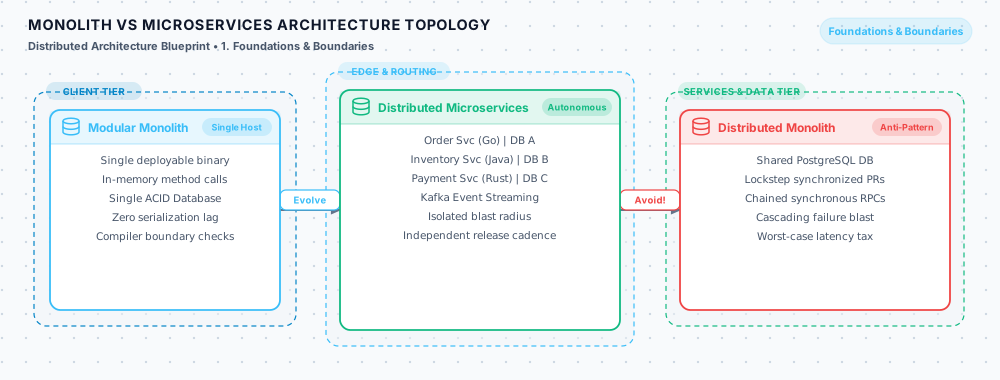
The Economics of Microservices: Velocity vs Distributed Complexity
Microservices are fundamentally an organizational scaling pattern rather than a purely technical performance enhancement. In a monolithic architecture, every deployment requires compiling, testing, and verifying the entire application; as engineering organizations grow beyond 50+ contributors, pull request queues collide, test suites take hours to execute, and a single nil-pointer exception in an obscure reporting feature can crash the checkout pipeline. Microservices decompose the system into autonomously deployable units aligned with business domains. However, moving code across network boundaries imposes a steep distributed systems tax: network latency, partial network partitions, data consistency challenges, and operational overhead.
Network Latency Tax: In-memory method calls take 10–50 nanoseconds; an RPC across availability zones takes 1.5–5 milliseconds—a 100,000x latency penalty per hop.
Independent Deployability: The golden litmus test: Can Team A deploy Order Service to production on a Friday afternoon without coordinating with, notifying, or redeploying Inventory Service?
Conway's Law Alignment: Any organization that designs a system will produce a design whose structure is a copy of the organization's communication structure. Autonomous teams require autonomous services.
Deployment Unit Blast Radius: In a monolith, memory leaks or infinite loops exhaust the global process heap; in microservices, resource exhaustion is constrained within container cgroups and localized pod limits.
The Distributed Monolith Anti-Pattern & Architectural Pitfalls
The single most dangerous failure mode in modern software engineering is creating a 'Distributed Monolith.' This occurs when teams adopt the operational complexity of microservices (Docker containers, Kubernetes clusters, service meshes, distributed tracing) without actually decoupling their data or business boundaries. If Service A cannot boot without Service B being online, or if both services write to the same relational database table, or if deploying a new feature requires synchronized releases across 4 codebases, you have constructed a distributed monolith that amplifies failure rates while killing development velocity.
Shared Database Coupling: Multiple services connecting to the same SQL schema binds them to identical data migrations and bypasses service-level business encapsulation.
Synchronous Call Chains: A front-end request triggering A -> B -> C -> D -> E creates multiplicative availability risk (if each service has 99.9% uptime, the 5-service chain has 99.5% uptime).
Lockstep Release Trains: Needing to merge four PRs across four repositories simultaneously proves that bounded contexts are flawed.
Leaky Domain Models: Exposing internal database entities directly over REST APIs couples downstream clients to internal storage schemas.
Migration Triggers: When and How to Transition
The industry consensus among experienced system architects is to start with a well-structured Modular Monolith. In a modular monolith, boundaries are enforced by language-level package visibility, strict interfaces, and separate modules within a single codebase. Transitioning to microservices should be triggered by concrete architectural inflection points rather than trend-following.
Independent Scaling Vectors: When the video transcoding pipeline requires 100 GPU instances while the user authentication service needs only 2 small web pods.
Distinct Fault Tolerances & Compliance: Isolating PCI-DSS payment tokenization or HIPAA medical records into dedicated hardened VPC boundaries with restricted access.
Team Velocity Saturation: When deployment friction, branch merge conflicts, and test execution times in the monolith measurably degrade feature shipping velocity.
Polyglot Tech Stack Justification: When machine learning model inference demands Python/PyTorch while the high-throughput matching engine demands Go or Rust.
Distributed Context Propagation & Latency Budget Enforcement
When migrating from monolith to microservices, maintaining end-to-end visibility and preventing cascading thread exhaustion across network hops is paramount. In a single process, execution state travels on the OS thread stack; in microservices, metadata must be explicitly serialized into protocol headers and carried across network boundaries.
W3C Traceparent Header Specification: Standardized 4-part wire format (version-trace_id-parent_id-trace_flags) ensuring trace continuity across HTTP, gRPC, and Kafka brokers.
Distributed Latency Budget Propagation: Every outbound client call must calculate remaining timeout budget: Budget_downstream = Budget_caller - Elapsed_time - Network_buffer. Downstream services immediately abort if Budget_downstream <= 0.
Baggage Propagation Mechanics: Passing non-functional contextual key-value pairs (tenant ID, request origin, feature flag cohorts) down the call chain without polluting business RPC signatures.
Cascading Cancellation via Protocol Control Frames: When upstream HTTP clients disconnect, the ingress gateway sends an HTTP/2 RST_STREAM or gRPC CANCEL frame to immediately abort downstream processing and free server worker threads.
Conway's Law & Team Topology Organization Models
System architecture and team organizational structures are inextricably linked. Building microservices with a functional team structure (a database team, a frontend team, and a backend team) inevitably generates high-friction communication bottlenecks and a distributed monolith. Microservices succeed only when paired with Cross-Functional Domain Teams.
Stream-Aligned Teams: Cross-functional units (product manager, frontend, backend, QA, DevOps) owning a single business domain end-to-end from conception to production operations.
Platform Teams: Internal engineering teams that provide self-service infrastructure (Kubernetes, CI/CD pipelines, observability stacks, service mesh) so stream-aligned teams do not reinvent foundational tooling.
Cognitive Load Limits: A single team should never own more domains than can fit within human working memory (Dunbar's number applied to software complexity). If a team owns 15 microservices, they are overwhelmed.
Enabling Teams: Specialists in security, performance, or distributed data that temporarily embed with stream-aligned teams to upskill them on complex architectural patterns.
Architectural Trade-Off Matrix
Evaluating production alternatives, concurrency bottlenecks, and operational costs.
| Architecture / Strategy | ✓ Key Advantages | ⚠ Trade-Offs & Failure Modes | ★ Production Recommendation |
|---|---|---|---|
| Modular Monolith | Zero network latency, single atomic ACID DB transactions, simple local development and unified debugging. | Single global blast radius; memory leaks or CPU spikes impact the entire system; slower CI/CD test runs at scale. | Early-stage products, greenfield systems, and engineering organizations with fewer than 30 developers. |
| Microservices | Autonomous deployments per team, fine-grained horizontal auto-scaling, polyglot tech stacks, isolated failure zones. | Distributed transactions require Sagas; eventual consistency; complex distributed tracing, networking, and service mesh overhead. | High-scale organizations (50+ engineers) with clearly defined domain boundaries and mature CI/CD infrastructure. |
| Distributed Monolith | Appears modern in high-level architectural presentation decks. | Highest latency, fragile lockstep deployments, cascading cluster failures, catastrophic operational cost. | Never recommended under any circumstances—refactor to modular monolith or properly decouple. |
GOD Microservices Interview Pro-Tip
When asked 'Should we build a microservices architecture?' in a system design interview, never answer with an unconditional yes. Open with: 'I advocate starting with a well-encapsulated Modular Monolith. I would only recommend microservices if we have distinct organizational scaling boundaries (Conway's Law), disparate scaling vectors (e.g. CPU vs Memory bottlenecks), or strict regulatory compliance boundaries.'